
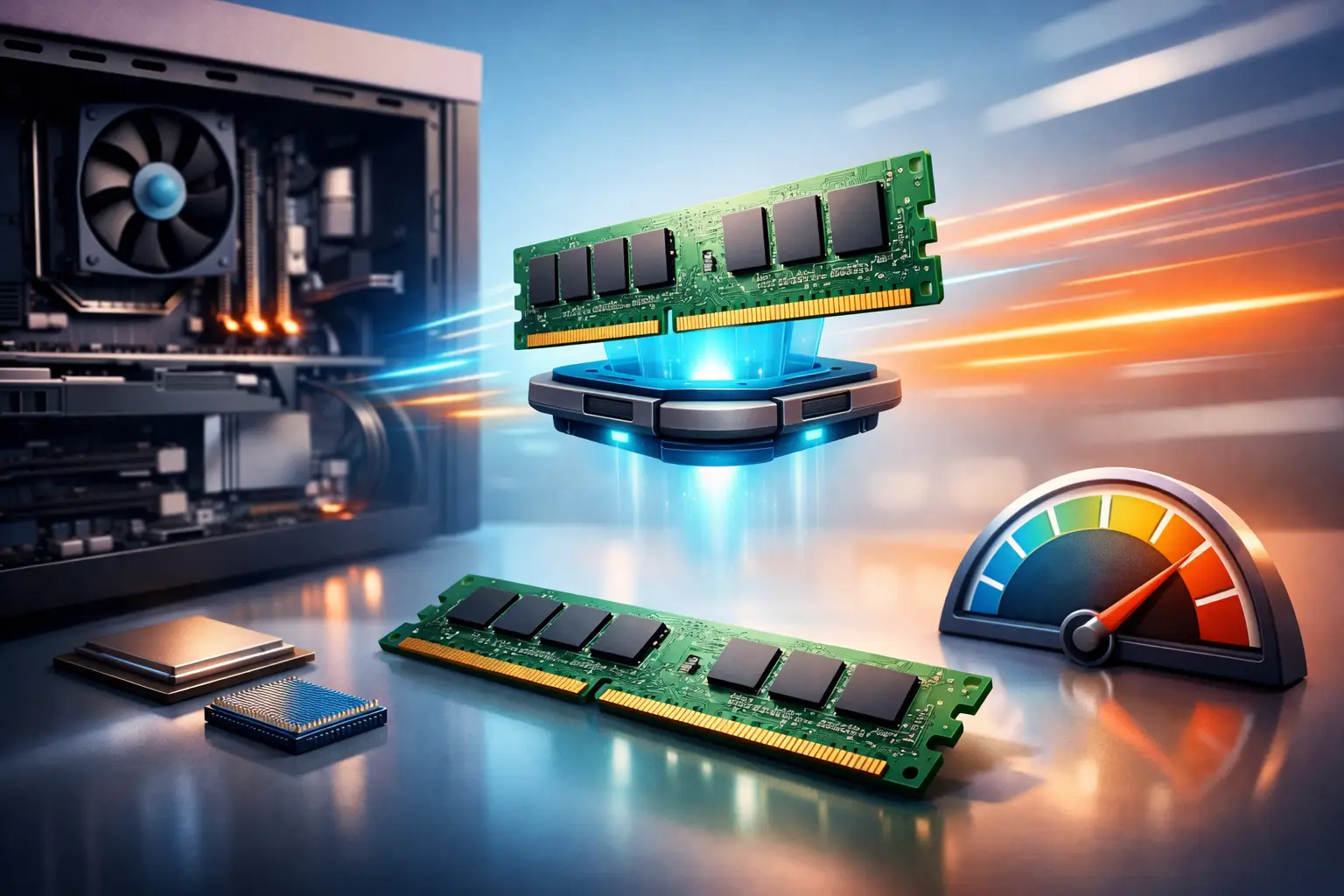
A desktop that takes too long to open a browser, freezes during video calls, or struggles with several everyday programs can make a simple task feel like a major interruption. For many PCs, the answer is to upgrade desktop memory for speed – but only after confirming that RAM is the real bottleneck. The right upgrade can make a noticeable difference in daily work, school, gaming, and small-business productivity without the cost of replacing the entire computer.
What Desktop Memory Actually Does
Desktop memory, usually called RAM, is the temporary workspace your computer uses while it is running. Every open browser tab, spreadsheet, email program, video call, and background process needs a portion of that workspace. When RAM fills up, Windows has to rely more heavily on the storage drive as temporary memory. Even with a solid-state drive, that is much slower than using available RAM.
This is why a computer may feel fine when it first starts, then become sluggish after you open several programs. You may see browser tabs reload unexpectedly, apps pause when switching windows, or the mouse cursor hesitate during a video meeting. Those are common signs that the system is short on usable memory.
RAM does not permanently store files, photos, or documents. Turning off the PC clears it. Storage – such as an SSD or hard drive – keeps your data when the computer is powered down. The two parts work together, but upgrading one does not always solve a problem caused by the other.
Signs You Should Upgrade Desktop Memory for Speed
The clearest sign is consistently high memory use during normal work. In Windows, Task Manager can show how much memory is in use. If memory regularly reaches 80 to 100 percent while you are doing the work you need to do, additional RAM may help.
Pay attention to the type of slowdown, too. A computer that is slow from the moment it powers on may have too many startup programs, malware, a failing drive, or an aging processor. A computer that slows down only when multitasking is more likely to benefit from a memory upgrade.
Common situations where more RAM can help include working with large Excel files, running accounting or POS software, editing photos and videos, using multiple monitors, playing newer games, keeping many browser tabs open, or running virtual machines. Remote workers often notice the difference when they have a video call, cloud storage sync, web browser, and business applications open at the same time.
For a family desktop, 8GB may still handle basic browsing and email, but it can feel restrictive quickly. For most current home, office, and student use, 16GB is a practical target. Systems used for demanding design work, video production, engineering applications, virtualization, or heavy multitasking may need 32GB or more.
More RAM Is Not Always the Right Fix
Adding memory is one of the best value upgrades available, but it is not a cure-all. If the desktop still uses a traditional hard drive as its main Windows drive, replacing it with an SSD may deliver a larger improvement in startup time, application loading, and overall responsiveness.
A machine with malware, damaged Windows files, excessive startup software, overheating, or a failing storage drive can also perform poorly regardless of its RAM capacity. Business computers with unreliable network connections may appear slow when the actual issue is a server, Wi-Fi, cloud service, or network configuration.
Older desktops have another limitation: they may not support current memory types or higher-capacity modules. Putting money into a decade-old PC can make sense for a specific purpose, but it depends on the condition of the system, the software it needs to run, and the cost of the compatible parts. A technician can help compare the price of an upgrade against the value of a replacement desktop.
Choosing Compatible RAM Matters
Desktop memory is not one-size-fits-all. DDR3, DDR4, and DDR5 are different generations of RAM, and their modules are physically and electrically incompatible. A DDR4 stick will not fit or function in a DDR5 motherboard slot, even if the capacity looks right.
Before buying memory, identify the desktop’s motherboard model or use the computer manufacturer’s specifications. You need to confirm the RAM generation, the number of memory slots, the maximum supported capacity, and the supported speed range. Prebuilt desktops from major manufacturers can have additional restrictions, especially compact office models.
Capacity is only part of the decision. Memory speed is measured in MHz or MT/s, but the motherboard and processor determine how fast it can actually run. Installing faster-rated RAM is sometimes fine, yet it may operate at a lower supported speed. That is not necessarily a problem, but it means paying extra for speed that the system cannot use may not be worthwhile.
For most customers, matching the current RAM is the safest approach when adding a module. Match the generation, capacity, speed, and ideally the brand and model number. If the existing memory is older, unknown, or unreliable, replacing it with a matched kit is often the better choice.
Why Matched Memory Pairs Make a Difference
Many desktop systems use dual-channel memory. This allows the processor to access two matched memory modules more efficiently than a single module. For example, two 8GB sticks generally provide better performance than one 16GB stick in a dual-channel system, especially in gaming, graphics-related tasks, and integrated graphics systems.
That does not mean every upgrade requires replacing all existing RAM. If your computer has one 8GB stick and an open slot, adding a compatible 8GB stick can be a cost-effective move to reach 16GB. If it has two occupied slots with mismatched modules, limited capacity, or unexplained crashes, a new matched kit may be more dependable.
Mixing RAM can work, but it carries trade-offs. The system usually runs all modules at the speed of the slowest compatible stick. Different modules can also create instability that does not appear until the PC is under load. For a desktop used to run a business, process payments, manage customer records, or support remote employees, reliability should take priority over a shortcut that saves only a small amount.
Installing Desktop RAM Safely
The physical installation is straightforward on many tower desktops, but careful handling matters. Shut down the computer fully, turn off the power supply if it has a switch, and unplug the power cable. Press the power button briefly after unplugging to help discharge remaining power.
Open the case on a clean, stable surface. Touch an unpainted metal part of the case before handling components to reduce static electricity risk. Find the long memory slots near the processor, release the retaining clips, and remove old modules only if necessary. Align the notch in the new memory with the slot, then press evenly until the clips lock into place.
Use the motherboard manual to identify the preferred slot order. On many systems, two modules should be installed in alternating slots rather than side by side. After reassembling the desktop, start it and confirm that Windows recognizes the new total memory.
If the PC does not start, powers on with no display, or reports less memory than expected, do not force anything. Shut it down and check that each module is fully seated in the correct slot. If the issue continues, the RAM may be incompatible, a slot may have a problem, or the system may need a BIOS update.
Test the Upgrade Before You Trust It
A desktop that boots after a memory installation is not automatically ready for important work. Check the recognized RAM amount in Windows, then use the computer normally for a few hours. Open the applications that previously caused slowdowns and look for crashes, blue screens, unexpected restarts, or program errors.
Memory testing is especially valuable after an upgrade to a work computer. Unstable RAM can corrupt files or cause intermittent problems that are difficult to trace. A professional diagnostic can verify the modules, check overall system health, and identify whether another component is holding performance back.
TN Computer Medics can assess slow desktop performance, recommend compatible memory, install upgrades, and check for related problems such as drive failure, malware, overheating, or Windows issues. That approach helps avoid buying parts that do not fit the system or spending money on an upgrade that will not address the real cause.
A well-chosen memory upgrade should make the desktop feel less strained, not merely increase a number in its specifications. If your computer is asking for more breathing room every time the workday gets busy, testing its memory use is a sensible next step.