
When your computer crashes during payroll, your office Wi-Fi drops in the middle of a workday, or ransomware hits a shared file folder, the debate around managed IT versus break fix stops being theoretical. It becomes about lost time, stressed employees, missed sales, and whether you can get back to work fast enough to avoid a bigger problem.
For many homes and small businesses in Tullahoma and nearby Tennessee communities, both service models can make sense. The right choice depends on how much downtime you can tolerate, how complex your technology has become, and whether you want help only after something breaks or ongoing support that works to prevent trouble in the first place.
Managed IT versus break fix: what is the difference?
Break-fix support is exactly what it sounds like. Something breaks, you call a technician, and you pay for the repair. That could mean a failed hard drive, a virus infection, a laptop screen replacement, a printer that will not connect, or a business network that suddenly stops cooperating.
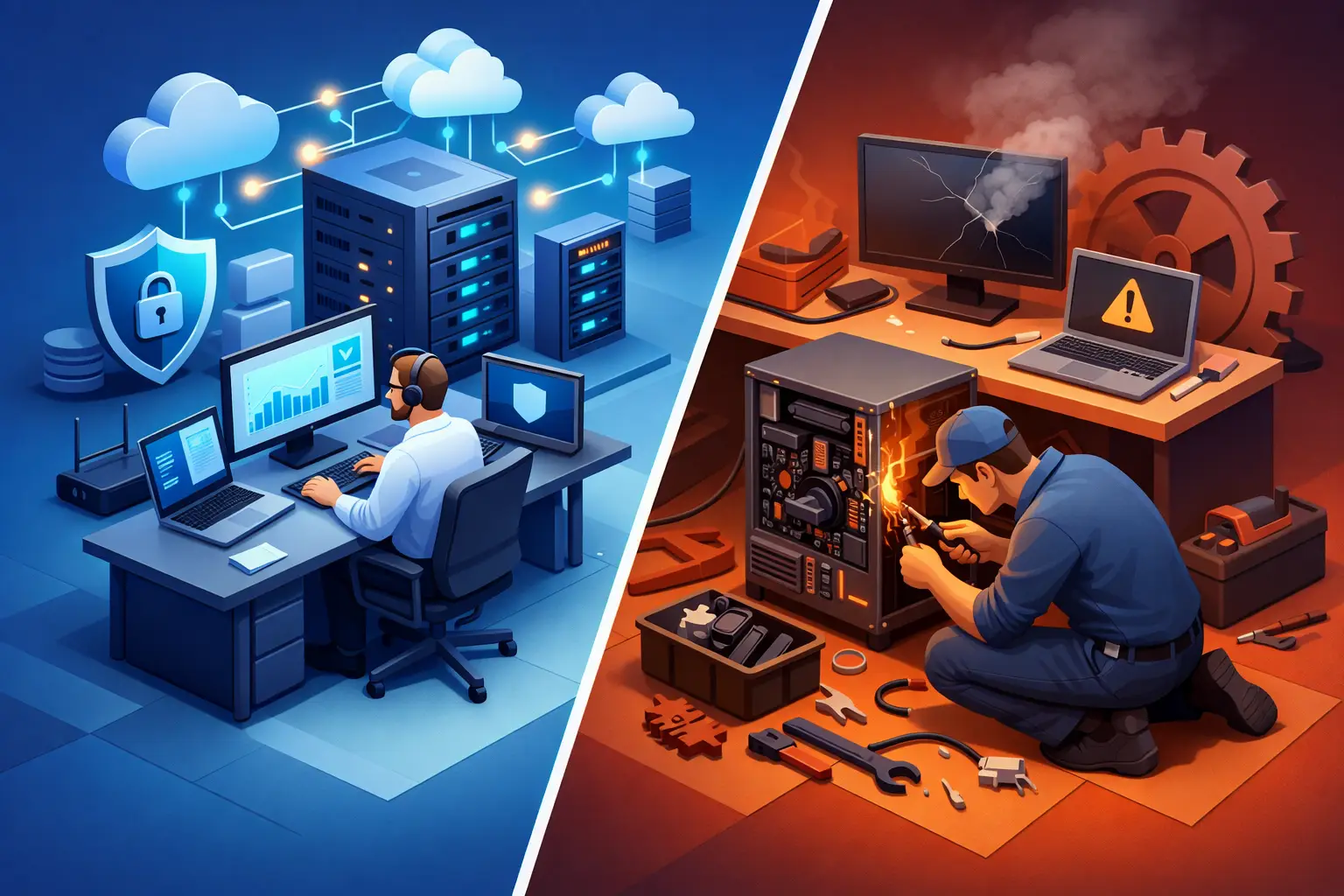
Managed IT works differently. Instead of waiting for a problem, you have ongoing support in place. That usually includes monitoring, maintenance, updates, security checks, backup oversight, and help desk support. The goal is not just to repair damage. It is to reduce the chances of damage happening at all.
The simplest way to think about it is reactive versus proactive. Break-fix responds to the emergency. Managed IT tries to prevent the emergency, or at least catch it early when it is smaller, cheaper, and easier to handle.
When break-fix still makes sense
Break-fix is not outdated, and it is not automatically the wrong choice. In many cases, it is practical.
If you are a homeowner with one family computer, a student with a cracked laptop screen, or a remote worker who mostly needs occasional repairs, break-fix can be the more affordable route. You are not paying for monthly service you may not use. You call when you need help, get the issue resolved, and move on.
It can also fit very small businesses with minimal technology needs. A shop with one point-of-sale device, one printer, and a couple of basic workstations may decide that occasional repair bills are easier to manage than a recurring support plan.
That said, break-fix works best when the consequences of downtime are limited. If a computer being down for a day is inconvenient but not business-threatening, the reactive model can still be reasonable.
Where break-fix starts to cost more than it looks
The challenge with break-fix is that the invoice never tells the whole story. The repair bill may be manageable, but the downtime often costs more than the fix itself.
If your front desk cannot access customer records, your team cannot print shipping labels, or your accounting system is offline, the real expense shows up in lost productivity. Staff still gets paid while work slows down. Customers wait longer. Deadlines slip. In some industries, even a short outage can affect trust.
There is also the timing problem. Break-fix support begins after the issue is already disrupting your day. By then, you may be dealing with corrupted files, an infected machine that spread trouble to others, or a hardware failure that damaged data before anyone noticed warning signs.
A reactive model can also lead to uneven budgeting. One month you pay nothing. The next month you replace a workstation, clean up malware, recover data, and troubleshoot a network problem all at once. For some businesses, that unpredictability is the biggest drawback.
Why managed IT appeals to growing businesses
Managed IT becomes more attractive as your dependency on technology grows. Once your internet, computers, printers, backups, security, and shared systems all affect daily operations, prevention starts to matter a lot more.
With managed support, routine maintenance does not get pushed aside until something fails. Software updates, patching, antivirus oversight, backup checks, and hardware monitoring become part of the plan. That can reduce surprise outages and help spot issues before they become expensive emergencies.
Security is another major reason businesses move toward managed services. Small businesses are frequent targets for phishing, weak passwords, unpatched software, and ransomware. In a break-fix arrangement, a technician may not get involved until after an infection or breach has already happened. Managed IT puts more attention on prevention, safer configurations, ongoing monitoring, and user support.
For business owners without an in-house IT department, that ongoing guidance can be just as valuable as the technical work. Instead of making every technology decision under pressure, you have a partner helping you plan replacements, improve reliability, and avoid avoidable mistakes.
Managed IT versus break fix for cost
At first glance, break-fix often looks cheaper because there is no monthly commitment. That can be true for people with simple needs and infrequent issues.
Managed IT usually comes with a recurring fee, which some owners hesitate to take on. But the value is in reducing downtime, smoothing out budgeting, and catching problems early. Over a year, a business that experiences several outages, security incidents, or neglected maintenance issues may spend more under break-fix than it would have spent on ongoing support.
Still, it depends on the environment. A family desktop used for homework and email may not need managed service. A medical office, law office, retail location, or growing company that depends on constant uptime probably has a different risk profile.
The right cost question is not just, “What do I pay the technician?” It is, “What does one hour of downtime cost me, and how often am I willing to gamble on that?”
How to tell which model fits your situation
If you are deciding between managed IT versus break fix, start with your exposure to risk.
If you can tolerate downtime, have only a few devices, do not store sensitive business data, and mainly need occasional repair help, break-fix may be enough. It is straightforward and works well for one-off problems like hardware replacement, virus cleanup, operating system reinstalls, and device troubleshooting.
If your business relies on shared files, cloud apps, email, point-of-sale systems, phone systems, remote access, or stable networking, managed IT is usually the safer path. The more moving parts you have, the more expensive reactive support becomes.
You should also consider whether your systems are already showing signs of neglect. Frequent slowdowns, recurring malware issues, backup uncertainty, aging hardware, and “temporary” fixes that never got revisited often point to a need for ongoing support rather than another isolated repair.
The middle ground many people overlook
This is not always an all-or-nothing decision. Some homes and small businesses use a hybrid approach.
For example, a business may keep managed support for network monitoring, cybersecurity, patching, and backups while still handling occasional hardware upgrades or one-time repair projects separately. A home office may need break-fix for a damaged laptop but also want ongoing help with backup strategy or router security.
That flexibility matters because every environment is different. A local business with five employees has different needs than a family household, and both look different from a company with multiple locations or compliance concerns.
A dependable provider should be honest about that. Not every customer needs a full managed plan, but every customer does need a clear understanding of their risks, their options, and what happens if a preventable issue turns into a major outage.
The local factor matters more than people think
Technology support is not only about technical skill. Response time, accountability, and familiarity with the customer matter too.
When you work with a local team, there is a better chance of getting practical support that matches your setup instead of a generic script. That matters when a business network is down, a remote worker needs help fast, or a family is trying to recover photos and files from a failing device.
For customers in this region, working with a company like TN Computer Medics means support that understands both urgent repair needs and longer-term business continuity. That local relationship can make the difference between a quick recovery and a prolonged disruption.
If your technology is mostly an occasional inconvenience, break-fix can still serve you well. If your devices and systems are tied directly to your income, your schedule, or your customers’ trust, managed IT deserves a serious look. The best time to think about support is before the next failure reminds you how much your technology really carries.